Showing posts with label Poetry and Plays. Show all posts

Sunday, February 12, 2012

►Henri Matisse - Words of wisdom


► Why have I never been bored? For more than fifty years I have never ceased to work. 
► When I put a green, it is not grass. When I put a blue, it is not the sky.
► I desire pleasure. I am not a revolutionary by principle. I was educated in an entirely different manner. 
► My mother liked everything I did. It is from her affection for her that I always drew what theory failed to offer me per finish the painting.
► Would not it be best to leave room to mystery?


► What interests me most is neither still life nor landscape: it is the human figure. 
► What I dream of is an art of balance, of purity and serenity, devoid of troubling or depressing subject matter, an art which could be for every mental worker, for the businessman as well as the man of letters, for example, a soothing, calming influence on the mind, something like a good armchair which provides relaxation from physical fatigue.
► Expression, for me, does not reside in passions glowing in a human face or manifested by violent movement. The entire arrangement of my picture is expressive; the place occupied by the figures, the empty spaces around them, the proportions, everything has its share.
► I have always tried to hide my efforts and wished my works to have the light joyousness of springtime, which never lets anyone suspect the labors it has cost me.... 
► Drawing is like making an expressive gesture with the advantage of permanence.


► I do not literally paint that table, but the emotion it produces upon me.
► Exactitude is not truth.
► Cutting into color reminds me of the sculptor's direct carving.
► Seek the strongest color effect possible... the content is of no importance.
► In modern art, it is undoubtedly to Cézanne that I owe the most.
► The essential thing is to spring forth, to express the bolt of lightning one senses upon contact with a thing. The function of the artist is not to translate an observation but to express the shock of the object on his nature; the shock, with the original reaction.
► I wouldn't mind turning into a vermilion goldfish.
► A young painter who cannot liberate himself from the influence of past generations is digging his own grave.
► There is nothing more difficult for a truly creative painter than to paint a rose, because before he can do so he has first to forget all the roses that were ever painted.
► You study, you learn, but you guard the original naiveté. It has to be within you, as desire for drink is within the drunkard or love is within the lover.
► An artist must never be a prisoner. Prisoner? An artist should never be a prisoner of himself, prisoner of style, prisoner of reputation, prisoner of success, etc.
► It has bothered me all my life that I do not paint like everybody else.
► I don't know whether I believe in God or not. I think, really, I'm some sort of Buddhist. But the essential thing is to put oneself in a frame of mind which is close to that of prayer.
► I would like to recapture that freshness of vision which is characteristic of extreme youth when all the world is new to it.


► There are always flowers for those who want to see them.
► Creativity takes courage.
► It is not enough to place colors, however beautiful, one beside the other; colors must also react on one another. Otherwise, you have cacophony.
► Work cures everything.
► Impressionism is the newspaper of the soul.
► I have always sought to be understood and, while I was taken to task by critics or colleagues, I thought they were right, assuming I had not been clear enough to be understood. This assumption allowed me to work my whole life without hatred and even without bitterness toward criticism, regardless of its source. I counted solely on the clarity of expression of my work to gain my ends. Hatred, rancor, and the spirit of vengeance are useless baggage to the artist. His road is difficult enough for him to cleanse his soul of everything which could make it more so.
► It is my dream to create an art which is filled with balance, purity and calmness, freed from a subject matter that is disconcerting or too attention-seeking. In my paintings, I wish to create a spiritual remedy, similar to a comfortable armchair which provides rest from physical expectation for the spiritually working, the businessman as well as the artist.

Tuesday, May 17, 2011

►Samuel Beckett - Black comedy and gallows humor

►"We are all born mad. Some remain so."- Samuel Beckett

Samuel Barclay Beckett (13 April 1906 – 22 December 1989) was an Irish avant-garde writer, dramatist and poet, writing in English and French. Beckett's work offers a bleak outlook on human culture and both formally and philosophically became increasingly minimalist in his later career.
He wrote both in English and French. His work offers a bleak, tragicomic outlook on human culture, often coupled with black comedy and gallows humor.


Beckett is widely regarded as among the most influential writers of the 20th century. Strongly influenced by James Joyce, he is considered one of the last modernists. As an inspiration to many later writers, he is also sometimes considered one of the first postmodernists. He is one of the key writers in what Martin Esslin called the "Theatre of the Absurd". His work became increasingly minimalist in his later career.
Beckett was awarded the 1969 Nobel Prize in Literature "for his writing, which—in new forms for the novel and drama—in the destitution of modern man acquires its elevation". He was elected Saoi of Aosdána in 1984.


Wednesday, April 13, 2011

►Percy Bysshe Shelley - Ozymandias

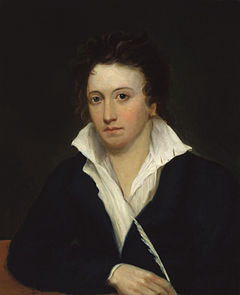
►Percy Bysshe Shelley (4 August 1792 – 8 July 1822) was one of the major English Romantic poets and is critically regarded among the finest lyric poets in the English language. Shelley was famous for his association with John Keats and Lord Byron. The novelist Mary Shelley was his second wife.


Percy Shelley

"Ozymandias" /ˌɒziˈmændi.əs/ is a sonnet by  Percy Bysshe Shelley, published in 1818. It is frequently anthologised and is probably Shelley's most famous short poem.


OZYMANDIAS
I met a traveller from an antique land
Who said: Two vast and trunkless legs of stone
Stand in the desert. Near them, on the sand,
Half sunk, a shattered visage lies, whose frown
And wrinkled lip, and sneer of cold command
Tell that its sculptor well those passions read
Which yet survive, stamped on these lifeless things,
The hand that mocked them and the heart that fed.
And on the pedestal these words appear:
"My name is Ozymandias, king of kings:
Look on my works, ye Mighty, and despair!"
Nothing beside remains. Round the decay
Of that colossal wreck, boundless and bare
The lone and level sands stretch far away.


...
The poem’s narrator presents the reader with a stunning vision of the tomb of Ozymandias, another name for Rameses II, King of Egypt during the 13th century B.C. Shelley emphasizes that to a modern viewer this tomb tells quite a different tale than that which Ozymandias had hoped it would. The king evidently commissioned a sculptor to create an enormous sphinx to represent his enduring power, but the traveler comes across only a broken heap of stones ravaged by time.
Enough of the original monument exists to allow Shelley a moment of triumph over the thwarted plans of the ruler. The face of Ozymandias is still recognizable, but it is “shattered,” and, though his “sneer of cold command” persists, it is obvious that he no longer commands anyone or anything. The vaunting words carved into the stone pedestal can still be read: “Look on my works, ye Mighty, and despair!” Yet he is to be pitied, if not disdained, rather than held in awe and fear: The broken-down tomb is set in a vast wasteland of sand, perhaps Shelley’s way of suggesting that all tyrants ultimately end up in the only kind of kingdom they deserve, a barren desert.

The 'Younger Memnon' statue of Ramesses II in the British Museum thought to have inspired the poem

Shelley’s sonnet, however, would not be the great poem it surely is if it were only a bit of political satire. The irony of “Ozymandias” cuts much deeper as the reader realizes that the forces of mortality and mutability, described brilliantly in the concluding lines, will erode and destroy all our lives. There is a special justice in the way tyrants are subject to time, but all humans face death and decay. The poem remains primarily an ironic and compelling critique of Ozymandias and other rulers like him, but it is also a striking meditation on time-bound humanity: the traveler in the ancient land, the sculptor-artist who fashioned the tomb, and the reader of the poem, no less than Ozymandias, inhabit a world that is “boundless and bare.”

Related Posts Plugin for WordPress, Blogger...