►Ma Liang aka Maleonn, born in Shanghai, China in 1972. He is a graduate of the Fine Arts College of Shanghai University where he studied graphic design.This talented Shanghai based photographer has gained a kind of cult following because of his fable-like photographs. His images, in color and black and white, are often created with props, actors and a strange mix of hues, colors and theatrical sets.
"The physical outward world is more and more complicated and chaotic. In such a ridiculous age shaped by plastic values, lots of things that are profound and noble are becoming doubtful. I'm trying to use my own way to reorganize this age in my eyes. I'm dancing with the music of the times exaggeratedly and ludicrously, even a little artificial. But, that is our irresistible fate. All that is just the plastic feeling surface. During the process of building up the work, what supports me is still the self-thinking and inspections towards the human being as an individual.
My work is my inner world. The moments in my works really have been existed in my fantasy. Sometimes I painted them one day before shooting. I painted so quickly even surprised myself sometimes. They are so clear in my mind that every detail exists there. I'd love to imagine and thinking all the day. I believe that I have a complete world inside my heart. With my 30 years growing, this world is being constructed more and more complicated. What I'm doing is to turn the images of this world into reality, that's all."
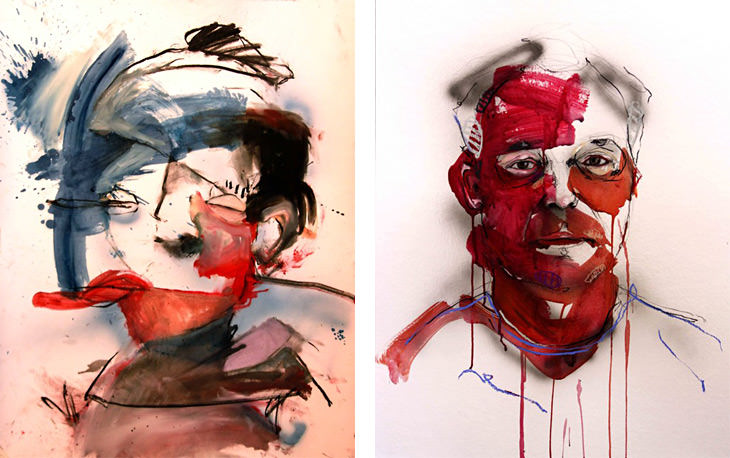
►Lou Ros, 26, began painting at the age of 17. Based in Paris, France, he started with graffiti for fun with friends which soon became a real addiction to him. His art represents the visible and not so visible worlds. With paint brush in his hands colors fly, dance and rejoice with pleasure and passion. Learning to paint without going through an art school, Lou felt the limits of his street art, admitting himself that:
"There is an ethics of aesthetic beauty and repetition that eventually bores me. Painting beautiful is boring, while making a painting that has strength is quite another thing. So I started painting at home. "
►Julian De Narvaez was born in Bogota, Colombia, in 1977 and graduated as a graphic designer at the Jorge Tadeo Lozano University in 2002, and in web development in 2004 at the same university. He attended National Art Institute IUNA, Buenos Aires, Argentina in 2009 for specializing in media and technologies program for artistic production. Julian De Narvaez’s work has appeared in various media channels in Colombia and Mexico since 2002.
He currently works with different editorial and design agencies in England, United States and South America.
►Ray Caesar was born in 1958 in London. At an early age, his family moved to Toronto, Canada, where he currently resides. From 1977—80 he attended Ontario College of Art, followed by 17 years from 1980—96 working in the art & photography department of the Hospital For Sick Children in Toronto, documenting disturbing cases of child abuse, surgical reconstruction, psychology, and animal research. Coupled with inspiration from surrealists Kahlo and Dali, Caesar’s experiences at the hospital continue to influence his artwork.
His haunting imagery is created digitally using 3D modeling software called Maya, mastered while working in digital animation for television and film industries from 1998—2001. In 1999, Caesar received a Primetime Emmy Nomination for Outstanding Special Effects in a series.
Caesar works in Maya (a 3D modeling software used for digital animation effects in film and game industries), using it to create his figures as well as the virtual realms in which they exist. Through the program, he builds digital models with invisible skeletons and anatomical joints that can be bent and manipulated to assume any pose. He wraps the models in rich textures, adding hair, skin, eyelashes and fingernails. Then places them in digitally lit, impeccably detailed 3D environments built with architectural layers, windows, wallpapers, curtains and furnishings. Caesar’s meticulous process incorporates elements of drawing, painting, collage and sculpture, working countless hours to achieve every remarkably intricate tableau. Further emphasizing his sculptural technique, Caesar compares his process of 2D printmaking with imagery created in 3D as being similar to the practice of capturing stills from video and film.
With full control over dressing, posing and lighting his figures as well as every element of their surroundings, Caesar’s craft is an advanced extension of a childhood obsession—playing with dolls. Fantasy, escapism, human cruelty and disguise are reoccurring themes explored within his dramatic narratives. Betraying the seemingly child-like innocence of the figures is their piercing, knowing gaze—exposing inner strength in contrast with their fragile physical appearance. Dark details manifest from deep within the artist’s vast imagination to define simulated realities, transporting the viewer into sanctuaries created for his lost ghost-children who emerge from shadows into safe refuge, carrying macabre secrets and hidden truths.
Artist's Statement...
"I was born in London, England on October 26 1958, the youngest of four and much to my parent's surprise, I was born a dog. This unfortunate turn of events was soon accepted within my family and was never again mentioned in the presence of polite company. I was a rambunctious youth as was natural to my breed but showed a fine interest in the arts as I drew pictures incessantly on anything including the walls and floors of every room of our tiny house. After some trouble with intolerant neighbors, my family was convinced to move to Canada and it was not long before the burgeoning town of Toronto became our new home.
Unfortunately the drawing continued to become somewhat atypical and aberrant and it was impressed upon me that such images might not be suitable for public viewing. In the summer of 69, there was a valiant attempt to stop me from doodling infamous contemptible fascist dictators upside down on my stomach with a ballpoint pen. I was consoled however by the encouragement to continue penciling in faces of flamboyant cowboys such as Gene Autry, Roy Rogers, The Lone Ranger and Tonto on my toenails but was expressly forbidden to talk to them at night.
It can be said that there are defining moments in a dogs life that can only be described as pivotal. Mine came when I received a gift of a flesh toned 12 inch plastic movable human doll attired in cheaply made military fatigues called "GI Joseph". I however named him "Stanley Mulver" and immediately resigned his commission from the light infantry. My Mother helped in this by sewing small business suits and leisure wear out of leftover Christmas fabric embroidered with holly and snowmen, tinfoil shoes and one tasteful Safari suit made of tight fitting powder blue rayon that proudly shone cobalt in the summer sunlight. It wasn't long before I had begun making enlarged wigs out of gray plasticine.
These wigs soon became huge pompadours for Stanley and looked even more grand when I meticulously embedded small hairs from my daily body and face shavings. This hirsute practice along with walking upright allowed me to fit in with other children even though my father considered it a waste of time. In short, Stanley had become a visage of the Man I could never be, of that elusive self one sometimes glimpses down the tunnel of infinite reflected mirrors. Although ridiculed by my peers, I proudly wore Stanley around my neck at all times as if to say "SEE! This is the man I will be, a good man, a kind man".
I have worked in many fields over the years, attended obedience classes and art colleges, jobs designing horrible buildings in architectural studios, medical art facilities, digital service bureaus, suspicious casino computer game companies, eventually working at computer modeling, digital animation and visual effects for television and film. Some award nominations have been attained and I have been driven in long black liquor filled limousines and walked on hind legs down red carpets in Pasadena while wearing strange smelling rented tuxedos.
Things change and summer years come to an end. My change occurred one night when my Mother visited me, which was slightly unusual because she had passed away some months before, a victim to the cigarette habit she could never quite lick. Facing a wall and slowly turning I saw the right side of her face ablaze in light, her hand trying to cover the light as if she were apologetic for having it seep through. Words were said about following rabbits down holes and I was shown galleries of work which were to be my own. My Mother was not the first visitation I have had and it seems she will not be the last.
I live in a brick house with my wonderful wife Jane and a coyote called Bonnie. I like eating avocados and I don't really mind being a dog".
Raoul Servais (born 1 May 1928) a Belgian filmmaker. One of my favorite recent purchases is Servais' L'Intégrale des courts métrages anthology from France. In addition to the ten short films in the collection, there are also extracts from all of his remaining films (including his one feature film, Taxandria), a near feature length documentary, an interview with Servais, as well as a commentary track on Night Butterflies where he discusses his aesthetic homage to Belgian artist Paul Delvaux through his portraiture of enigmatic women wearing allusive (or elusive) masks. Stylistically evolving from avant-garde art movement inspired animation, to monochromatic, rough hewn pen and ink styled animations reminiscent of op-ed political cartoons, to his more recent films that transect the bounds of live-action and animation, Servais' films are magical, pensive, and provocative alchemy of passion, conscience, and inspired - and inspiring - creativity.
The False Note, 1963
Wryly subtitled as an "old twentieth century legend" fable set "in the days when some people still knew what it was to go hungry", The False Note is the dialogue-less tale of a down on his luck organ grinder whose out of tune portable barrel organ produces a cacophonous, errant false note at the end of an evocative, downbeat serenade that invariably sets the once attentive audience into a hostile and uncharitable mood. Wandering through the streets of a cosmopolitan city rife with images of consumerism, the doleful hero encounters first hand the melancholy of obsolescence, as the rudimentary music emanating from his hand-cranked barrel organ is rebuffed in favor of the novel technologies of an amplified jukebox and the mesmerizing, peripatetic lights of a pinball machine, until he finds a momentary kindred spirit in a carousel horse enshrouded with cobwebs at an abandoned carnival. Raoul Servais' impressive animation is something of a Pablo Picasso drawing study crossed with the silent expressiveness of Marcel Marceau, replete with a richness of imagery that not only juxtaposes the theme of the false note against iconic images of currency, but also the innate inhumanity of a rootless, disposable society.
Chromophobia, 1966
Servais achieved international acclaim with his ground-breaking, anti-militarist fable on repression, perseverance, and the indomitability of the human spirit, Chromophobia, a compact, yet articulate parable of an aggressive, chromophobic army that marches into an idyllic kingdom and systematically terrorizes the population by erasing all traces of color within its periphery, until a little girl unexpectedly cultivates a lone, resilient red flower in her garden. Evoking the instinctual compositions of a more geometric Joan Miró, the film is particularly remarkable in Servais' illustration of resonant, iconic symbolism: a balloon that is converted into a ball and chain mirrors the town's spiritual captivity, the transformation of trees into gallows represents the corrupted interrelation between life and unnatural death in times of war, flowers emerging from the barrel of a rifle reflects a restoration of peace and gesture of renewed humanity.
Sirène, 1968
In hindsight, Sirène can be seen as Servais' transitional composition from his early, more conventional animated art films to the rawer, more visceral works that would define his early 1970s oeuvre. A somber, surrealist tale that fuses prehistoric and modern, reality and myth, the film revisits the double entendre of The False Note in its prefigurative sound of an emergency siren that accompanies the title sequence. Opening to a curious encounter between two competing cranes as they attempt to take possession of an unloaded crate with disastrous results, this image of primitive territoriality would subsequently be repeated (with even more horrifying consequences) in a King Solomon-styled arbitration between a medical and a zoological institution after a mermaid is found on the docks of a phantom shipyard. In contrast to the cheerful caricatures of his earlier films, the dour, ghostly images of Sirène recall the gothic figurations of Edward Gorey in its cautionary fable on the myopia of humanity in the "civilized" quest for equitable justice.
Goldframe, 1969
Goldframe is the first film to emerge in what would be Servais' more elemental period, a film that derives implicit irony in its deconstructed, monochromatic, pen and ink illustration of a bombastic, larger than life Hollywood studio executive who demands, at all cost, to be the first to have the technology for a 270mm film. Turning up in a projection room that is outfitted with an undersized (and self-aggrandizing) director's chair to watch, not the rushes of the latest film, but his own shadow cast by his hand-selected spotlight, the film culminates with Goldframe's empty, narcissistic mano a mano posturing challenge against his own shadow, and in the process, creates an acerbic commentary on egoism and the obsessive pursuit of one upsmanship.
To Speak or Not to Speak, 1970
The Vietnam War undoubtedly fuels Servais' anti-militarist, anti-authoritarian sentiment in To Speak or Not to Speak, as a roving reporter asking the loaded question, "What's your opinion about the actual political situation?" serves as a springboard for a critical examination on social conformity, consumerism, and bohemianism... the questions answered with inarticulate disfluencies that quickly overrun the speaker's thought bubble, become entangled with such empty confusion that a spider web forms within it, or resort to tried and true mantras. Perhaps the most incisive - and prescient - episode in the film is the re-appearance of the reporter as an embedded war correspondent who plays it safe with fluff opinion pieces that skirt around the consequences of war before being confronted by its grim reality. Rather than obliquely addressing the social inertia and petty self-interest that enabled the protraction of war, Servais directly engages issues of censorship, political doublespeak, and the corruption of information in the dissemination of news as propaganda.
Operation X-70, 1971
The specter of the Vietnam War - and particularly, the U.S. government's controversial use of chemical weapons - also casts a somber pall over Servais' next film, Operation X-70. The film opens with a slideshow projection of a clandestine scientific experiment (that stylistically evokes Chris Marker's La Jetée) presenting the laboratory results of a new, non-lethal chemical weapon that places the Asiatic subjects in a lethargic, euphoric state in order to "help them to rediscover their deep, religious nature". Immediately winning the endorsement of the country's gas-mask hooded religious leader (dressed in a not-too-subtle Klansman-like ensemble) who extols the virtues of X-70 as a clean weapon that doesn't kill and is, therefore, "in accordance with our Christian civilization", the chemical weapon is soon dispatched for bombardment of its Pacific targets, until an aircraft's malfunctioning navigational system sends its payload on an unexpected international course. Winner of the Jury Prize for Short Film at the 1972 Cannes Film Festival, Operation X-70 is a sobering, trenchant, and immediately relevant examination of cultural arrogance, religious fanaticism, and racism. Exposing the intrinsic inhumanity and hypocrisy of deploying "humane weapons" (such as targeted, non-civilian, collateral damage air strikes) in the waging of war, Servais boldly - and defiantly - engages the social conscience in confronting moral issues of escalating aggression, humane treatment, privilege, and righteousness.
Pegasus, 1973
Returning to the more traditionally rooted animated art films of early works such as A False Note and Chromophobia, Servais channels the rough stroke expressionism of Vincent van Gogh to create one of his most artfully rendered films, Pegasus, the tale of an aging blacksmith who whiles away his empty days trying to swat an errant fly with a forging hammer, until the appearance of industrial farm machinery in the village leads him to create a false god in the shape of an iron horse in a desperate attempt to stop the encroachment of technology. A cautionary fable on idolatry and psychological self-imprisonment, the film also represents a counterpoint to the inhumanity of technology gone amok in Operation X-70, where resistance to change, willful ignorance, and failure to adapt to new ideas become a figurative regression into the Dark Ages of self-created imprisonment, blind worship, and obsolete rituals.
Harpya, 1979
Although Servais has explored emotional and psychological horror within a framework of exploring social conditions and the effects of war in his previous work, his first foray into the genre is with the phantasmagoric, surreal fusion of live action and animation film, Harpya, a film that was awarded the Palm d'or for Short Film at the 1972 Cannes Film Festival. Subverting the damsel in distress tale, the film follows the fate of a well-intentioned passerby who comes to the aid of a woman apparently being strangled by a man in the cover of darkness - and who, in turn, turns out to be, not a woman, but a half woman, half bird of prey mythological harpy. Devouring everything inside his home, the harpy soon imprisons him to a life of resigned servility (in a gruesome act that foretells the mutilated captivity of Boxing Helena) until the lulling sound of a phonograph offers him a chance at escape. A radical departure from the humanist mythological fable of Sirène, Harpya's psychologically dark and grotesque imagery instead shares greater thematic affinity with the autonomous shadows of Goldframe and induced chemical mutations of Operation X-70 to create a disturbing cautionary tale on the perils of intervention and the implicit violation of natural order.
Atraksion, 2001
On a parched and desolate landscape, a group of shackled prisoners walk in eternal limbo around a borderless prison yard until one day when an inmate spots a ray of light emanating from beyond the view of a steep and treacherous mountain and decides to climb towards its source in the naïve hope that liberation awaits at the end of the trail. Returning to the distilled, monochromatic palette of Goldframe and Operation X-70, Atraksion represents Servais' introduction to digital post-processing. Adapting the allegorical flight of Icarus into a modern day metaphor for self-imprisonment (a theme that also pervades the vaguely mythological Pegasus), Servais implicitly (and incisively) embraces the virtues of new technology through the prisoners' realization of a transformative paradigm shift, to create a metaphoric, yet personal tale of re-invention, creativity, experimentation, and artistic fearlessness.
Dreaming it & doing it...
An artist on a mission to discover, explore, create, love and inspire an artful life.
I strongly believe in creative thinking and feel that design can be fanatic often and complicated which on the other side keeps the basis for creative experiments. I know that I always desire more than I accomplish at the moment, but the art is never ending story,…abounded unfortunately yes…
If you could read my mind, what a wonderful tale my thoughts would tell ...